Mycenaean palace societies
Fortified centers, Linear B administration and far-reaching exchange networks.
Aegean world, c. 1600-31 BCE
Hellas
Not one state but a network of poleis, islands, sanctuaries and colonies linked by language, exchange, competition and ritual.
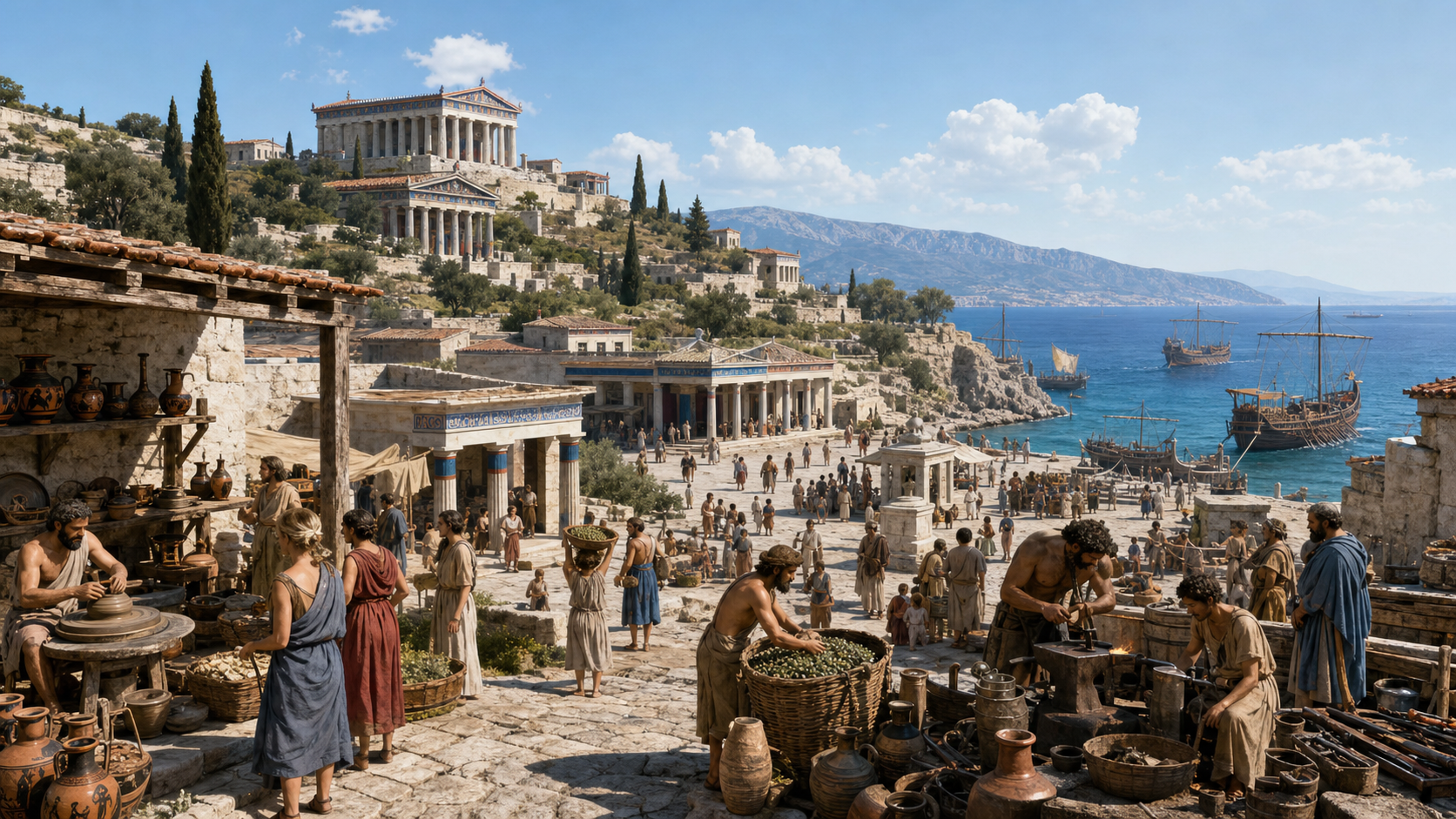
Begin with an ordinary dayOriginal interpretive reconstruction. Details synthesize archaeological evidence; it is not a photograph.
Core geography
Aegean Sea, Balkan peninsula, western Anatolia and coloniesPolitical unit
The polis: an independent city-state and its countrysideEconomic base
Grain, olives, vines, herding, craft production and maritime tradeEvidence
Settlements, inscriptions, pottery scenes, tools, sanctuaries and textsLong view
Dates are approximate and regional. The purpose is to prevent objects and practices from different centuries being shown as one timeless culture.
Fortified centers, Linear B administration and far-reaching exchange networks.
Regional settlement patterns and new iron technologies develop after palace collapse.
Poleis consolidate; alphabetic writing, overseas settlements, sanctuaries and new political forms spread.
Athens, Sparta and other powers compete; democracy, drama, philosophy and imperial warfare reshape public life.
Greek language and institutions circulate through large successor kingdoms and cosmopolitan cities.
Lived time
A composite day reveals recurring work, movement and ritual while keeping status and regional differences visible.
Water was fetched, hearths relit and bread prepared. Farmers and enslaved laborers left for small grain plots, olive groves, vineyards or pasture outside the walls.
Potters, smiths, leatherworkers, carpenters and textile workers produced in courtyards or small shops. Skill, citizenship and legal status did not always align.
Markets, lawsuits, contracts and public notices met in the civic center. In democratic Athens, eligible male citizens might attend an assembly or jury; most inhabitants could not.
Boys in some families learned letters, music and athletics. Adults handled trade, religious duties, military training or estate management.
Families offered small gifts or libations at domestic shrines and ate bread, pulses, olives, vegetables, fish or occasional meat according to means.
Elite men might attend a symposium; women managed household production and family rites; workers, migrants and enslaved people followed very different routines.
Home & body
Daily life was produced through food, water, housing, clothing, kinship and unequal access to labor and resources.
Greek houses often turned inward around a courtyard. Cooking, textile production, storage, childcare, sleeping and small-scale commerce shared the same rooms; furniture was portable and sparse.
Barley and wheat, legumes, olives, wine, figs, cheese and fish formed common patterns. Meat was less routine for many households and strongly associated with sacrifice and feasting.
Fountain houses, wells and cisterns supplied communities. Fetching water was daily labor, frequently represented as women's work in Athenian imagery.
Rectangular lengths of woven wool or linen became chitons, peploi and cloaks. Spinning and weaving were major skilled activities and powerful symbols of household order.
Political participation in Athens was limited to adult male citizens. Women, resident foreigners, enslaved people and children formed much of the population but lacked the same civic rights.
Families used diet, baths, exercise, herbal remedies, divination and sanctuary healing. Professional medical traditions developed alongside ritual approaches.
Production & exchange
The spectacular monument depended on ordinary systems of land, skill, transport, accounting and coerced or dependent labor.
Smallholders and estate laborers planted cereals, tended vines and olives, kept goats and sheep, and timed tasks to dry summers and winter rain.
Specialized workshops prepared clay, threw or shaped vessels, painted figure scenes and fired kilns. Attic fine wares traveled across the Mediterranean.
Smiths cast bronze, forged iron tools and weapons, and repaired fittings. Carpenters built roofs, furniture, carts and ships with scarce, valuable timber.
Sailors, merchants, dock laborers and money changers connected ports. Grain, timber, metals, ceramics, oil, wine and enslaved people moved through these networks.
Magistrates, jurors, soldiers, rowers, priests and festival organizers sustained the polis. Duties, payment and access varied by city and period.
Enslaved people worked in homes, workshops, agriculture, mines and administration. Their lives are essential to the economy but are often filtered through elite sources.
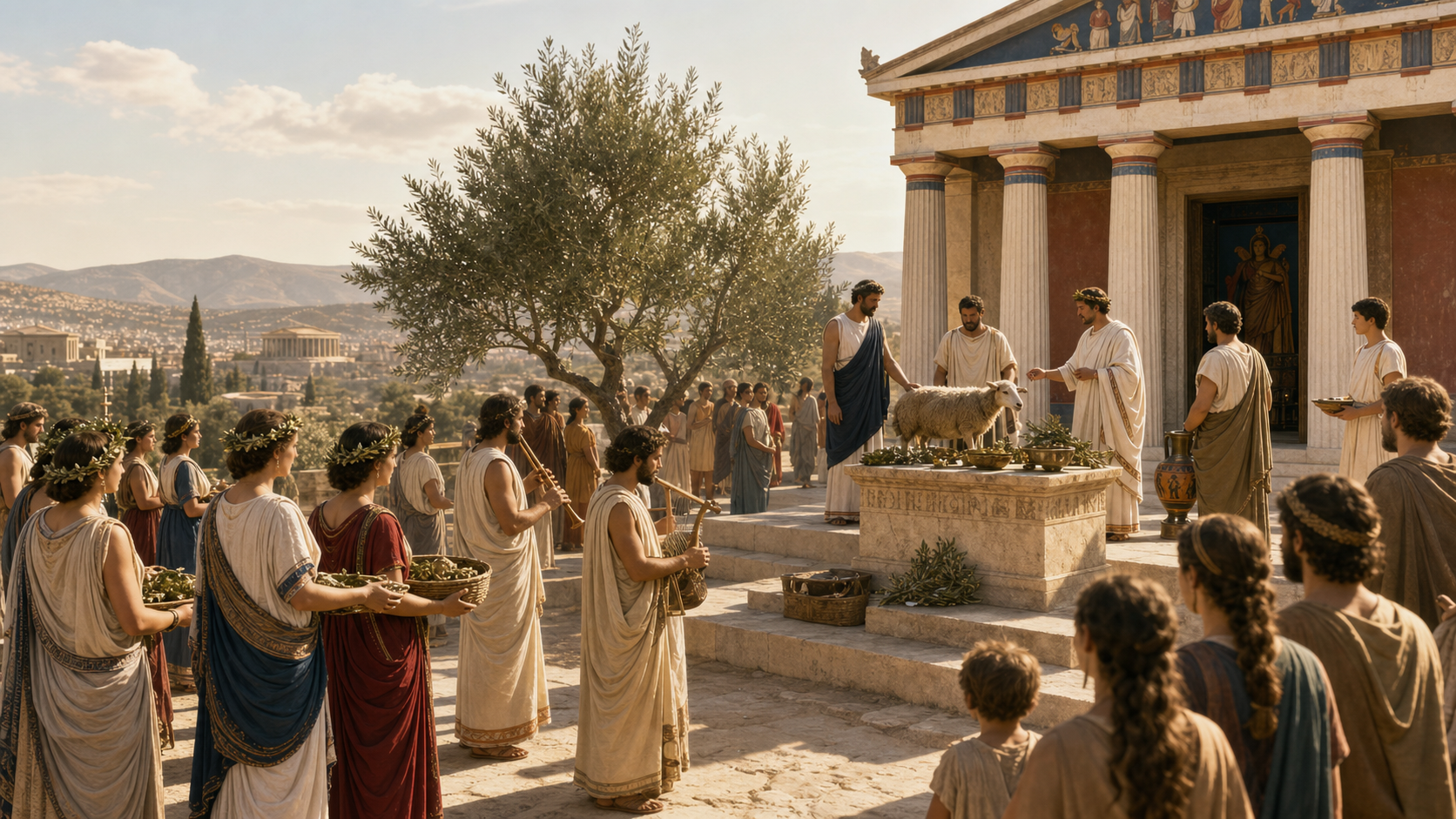
Original interpretive reconstruction. Ritual access and actions are simplified for one readable scene.
Ritual practice
Greek religion was enacted through correct relationships with gods, heroes and communities. There was no single scripture or centralized church; families, cities, associations and sanctuaries maintained overlapping calendars and obligations.
Participants washed or were sprinkled before approaching a sacred space.
Citizens, musicians, officials and offering-bearers moved together to make the community visible.
People named the deity, recalled past favor and presented incense, cakes, first fruits, libations or valuable dedications.
At major festivals, a domestic animal was consecrated at an outdoor altar. Selected portions went to the deity; cooked meat could become a communal meal.
Athletics, drama, music, dance and civic display were often religious acts, not separate entertainment.
Small shrines, ancestor observances and daily libations linked religion to the doorway, hearth and family meal.
Sacred figures and powers
Sky, order, oaths and hospitality; worshipped under many local titles.
Craft, strategy and civic protection; especially prominent at Athens.
Prophecy, music, healing and purification; Delphi linked communities across the Greek world.
Grain, seasonal fertility and initiation, notably at Eleusis.
Wine, transformation and theater; honored in processions and performances.
Founders and exceptional dead could receive offerings at tombs or dedicated shrines.
Power & belonging
Status came from overlapping legal, political, household, occupational, gendered and dependent relationships.
Legal identity, landholding, military duty and political voice were organized through the household and polis.
Women carried central domestic, economic and ritual responsibilities. Their property rights and public movement varied by place, status and period.
Resident foreigners could be vital merchants and craftspeople while remaining outside the citizen body.
War, piracy, trade and birth produced enslaved populations with no uniform experience; some held skilled or managerial roles, but coercion defined the condition.
Material lives
Objects connect technique to routine: each one belongs to a chain of material sourcing, skilled labor and social use.
Two-handled transport and storage jar for wine, oil, grain and other goods.
Fired-clay weight that kept warp threads taut on an upright loom.
Wide drinking cup strongly associated with the symposium.
Large round shield used by heavily armed infantry; costly equipment tied warfare to household means.
Curved scraper used with oil to clean the skin after exercise.
Stamped metal facilitated some markets and payments, while barter and weighed value also persisted.
Named lives
A name survives because a document, monument or later tradition preserved it. Famous rulers are placed beside poets, workers and officials where evidence allows.
Poet from Lesbos, active around the late 7th and early 6th centuries BCE; her surviving fragments reveal song, community and desire.
Athenian lawgiver and poet associated with early 6th-century reforms and debates over debt and citizenship.
A leading Athenian statesman of the 5th century BCE, inseparable from democracy, empire and monumental building.
A Milesian resident of Athens linked by later authors to rhetoric and the intellectual circle around Pericles.
Spartan king remembered for Thermopylae; useful only when set within Sparta's militarized citizen system and dependent labor.
Macedonian king whose conquests created the political setting for Hellenistic kingdoms and cities.
Atlas
Each site offers a different scale of evidence: house, port, sanctuary, capital, cemetery or workshop settlement.
A democratic polis, imperial center and port complex; not a template for every Greek community.
A land-based state whose citizen system depended on helot labor and distinctive institutions.
Panhellenic sanctuary where Apollo's oracle, treasuries and festivals joined religion to diplomacy.
Sanctuary of Zeus and setting for an athletic festival among many Greek competitions.
Strategic isthmus city with strong craft and maritime connections.
Hellenistic royal metropolis in Egypt, a center of scholarship, trade and mixed populations.
Source ledger
Museum, university, archaeology-department and UNESCO resources are used as starting points. Follow the links for object records, excavation reports and deeper bibliographies.
Object-based evidence for farming, childhood, women, war, shipbuilding and woodwork.
The British MuseumSanctuaries, offerings, sacrifice, festivals and the civic character of Greek worship.
The Metropolitan Museum of ArtA close account of the elite male drinking gathering, its vessels, rules and entertainment.
The Metropolitan Museum of ArtPottery production, Mediterranean export, visual evidence and cultural change.
The Metropolitan Museum of ArtMuseum learning framework for interpreting work, home, religion, gender, slavery, sport and myth.
Ashmolean MuseumVisual reconstructions were generated for this site from detailed historical prompts. They are labeled as interpretations and are never used as evidence for a claim. Source links support the written account.